"It matters little to me whether my pupil is intended for the army, the church, or the law. Before his parents chose a calling for him, nature called him to be a man...When he leaves me, he will neither be a magistrate, a soldier, nor a priest; he will be a man."- Rousseau
Having convinced myself of the benefits of continuous learning, it was a happy coincidence to have found a magisterial work- Great Books of the Western World. Established as a project by University of Chicago, the 54 Volume set (later expanded to 60 sets) aims to compile books with 'The Great Conversation' about the great ideas and their relevance in today's world.
I picked up the first volume- The substance of a Liberal Education.
 |
| Hutchins (left) with Benton of Encyclopædia Britannica |
The substance of a Liberal Education
It is here that Robert M. Hutchins gives a comprehensive rebuke to sociological determinism- a belief that intellectual activity is always relative to a particular society, so that if society changes in an important way, the activity becomes irrelevant. It is this determinism which has led to decline of education through Great Books, and by extension, through ideas which owe their development to centuries of intellectual wresling. Why shouldn't everyone study Shakespeare, or Newton, or Milton- he asks. The moral and intellectual impoverishment that their absence create is for real. He despises the all pervasive belief in education system to make it superficially relevant and easy, which has limited the scope, as well as the depth of understanding education is expected to provide.We live in an age where democracy provides for each adult to exercise complex choices of economics, politics, law, governance, religion and philosophy. And yet, the democracy does a poor job of providing adequate training for this monumental task. We are constantly bombarded by propaganda, half-truths and shallow treatment of important issues. From shrill political cries of what nature American state should take to silly studio discussions we have in India about the communal identity, the nature of debate that an average 'educated' person should participate in has declined.
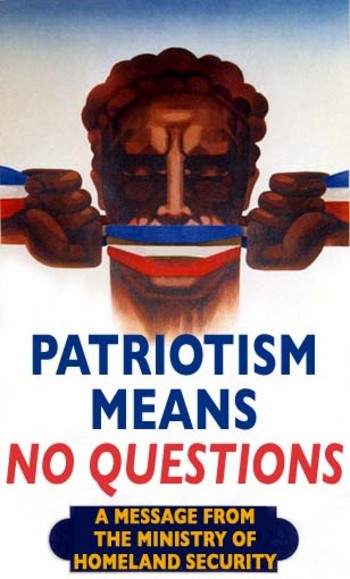 |
| "Propaganda is to a democracy what the bludgeon is to a totalitarian state." —Noam Chomsky |
"As the principle of an aristocracy was honour, and the principle of tyranny was fear, the principle of democracy was education."- Montesquieu
For a great time in our history, a large section of society was deliberately kept-off from the decision making process because of their isolation from ideas which guide intelligent decision making. Now politics gives everyone the power to make the decision. But if we believe that an education system is a society's attempt to perpetuate itself, education should make us responsible citizens and not half-zombie automatons. It should stand up for ideals which are universal in spirit, and essential in function- human rights, liberty, freedom of expression, rule of law, individual freedom, et cetra. The sort of cultural provincialism and narrow jingoistic outlook that we see on display is probably one of the greatest damnation of our educational system.
But even beyond the regular calling of a democracy, this education through books is still fundamental to our definition of what constitutes humanity. A person should use his mind, broaden his intellectual experience anddevelop his highest powers, for in its absence he would cease to be a person. And a free man will only want to live in a society which makes an attempt to develop his faculties, and provide him an opportunity to work towards the development of his fellow men. This, Hutchins says, is the best defense of nations- the character and intelligence of its people and comprehension of values of what nation stands for.
 |
| Great Books collection :) |
Great Books and my Reading Plan
So I have decided to spend next 10 years with the Great Books of the Western World. The only compunction I have is my shameful ignorance about my own culture. I don't know about the rest, but I have often wondered if this rootlessness is because of my education or in spite of it. I would come back to what India has to offer sometime in my life. Wouldn't it be a wonder for someone to have made a compilation of our very own Great conversation by then- ideas which every Indian should know of? In our times of Hindu vs Musalmaan, Brahmin vs Dalit, Bihari vs Marathi vs Madrasi, this can be a useful beginning for a question we often forget to ask- what makes us Indian?
Here is my reading
plan for [the end of] October, November and December of 2012:
1. Robert
Hutchins’s The Great Conversation
2. Plato’s Apology,
Crito
3.
Aristophanes’s Clouds, Lysistrata
4. Plato’s Republic
[Book I-II]
5. Aristotle’s
Ethics [Book I]
6. Aristotle’s
Politics [Book I]
7. Plutarch’s The
Lives of the Noble Grecians and Romans [Lycurgus, Numa Pompilius,
Lycurgus and Numa Compared, Alexander, Caesar]
8. Augustine’s
Confessions [Book I-VIII]
9.
Machiavelli’s The Prince


do read The Republic (all volumes,if can be),Laws and then Aristotle's works (in that order)...u can den have a better comparative analysis of the works of these 2 great thinkers
ReplyDeleteFormidable reading list ..... and a good start to what I hope will be a series of critiques on the sorry state of our education system
ReplyDelete